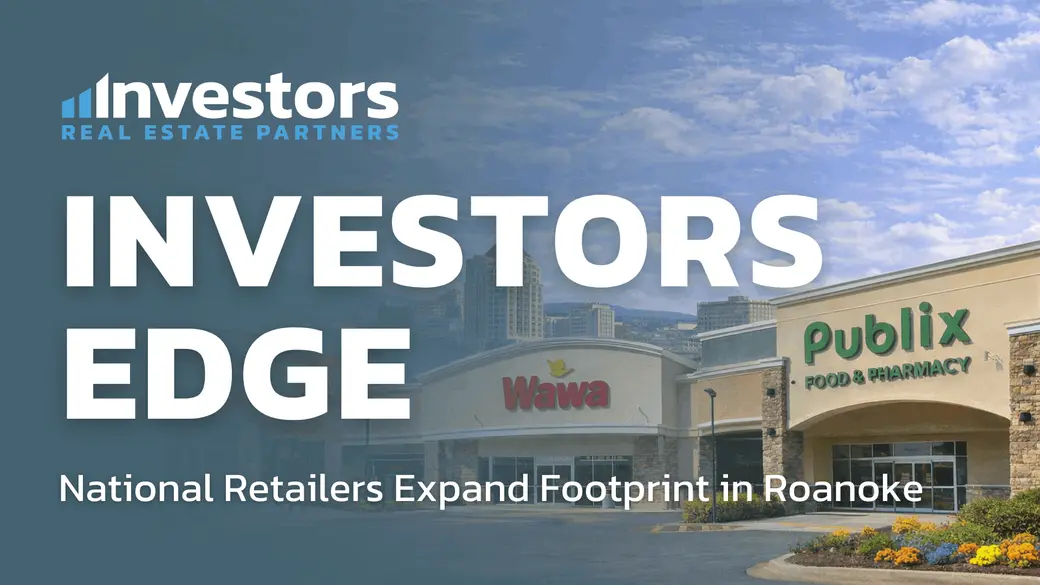
National Retailers Expand Footprint in the Roanoke Valley
What This Trend Signals for Local Businesses, Investors, and Consumers
Over the past year, the Roanoke Valley and surrounding Southwest Virginia markets have seen a steady increase in national and regional retail brands establishing a presence. Names like Cook Out, Wawa, First Watch, and 7 Brew Coffee have either opened locations or announced plans to do so, adding to the growing visibility of national retailers across the region. In addition, continued interest surrounding a planned Publix site in Roanoke has drawn attention from investors and residents alike, signaling how grocery and daily-needs retailers continue to evaluate the long-term fundamentals of the market.
Beyond individual openings, this activity reflects a broader and more intentional effort to attract national retail investment. The Roanoke Valley’s partnership with Retail Strategies, a national retail recruitment firm, has positioned the region for additional brands that have historically bypassed markets of this size. Current recruitment efforts are targeting retailers such as Trader Joe’s and Costco for potential future locations in Roanoke and Salem.
Taken together, these developments suggest a market that is increasingly being evaluated through an institutional lens rather than viewed as a secondary or tertiary afterthought.
Why National Retailers Are Targeting Southwest Virginia
Retail site selection has become highly data driven. National brands evaluate traffic volumes, household income trends, workforce stability, regional draw, and long-term population patterns before committing to a new market.
Roanoke functions as a regional hub for healthcare, education, logistics, and professional services, drawing consumers from a wide geographic area. Salem benefits from strong corridor visibility and commuter traffic, while Christiansburg continues to attract retailers due to its proximity to Virginia Tech, Montgomery County growth, and established retail infrastructure. The recent openings of 7 Brew Coffee in Salem and Christiansburg highlight how quick-service and drive-through concepts are prioritizing these submarkets.
Lynchburg and Lexington are also seeing increased interest tied to institutional anchors and steady employment bases. For national retailers, these markets offer a combination of lower operating costs and reliable demand without the saturation found in larger metropolitan areas.
Backfilling Vacant Big-Box Space
Another notable signal of retail health is the ability to backfill large format vacancies. The transition of the former Bed Bath and Beyond space to HomeSense illustrates how national retailers are stepping in to reuse existing big-box footprints rather than waiting for new construction.
This type of adaptive reuse is important for landlords and municipalities alike. It stabilizes retail centers, maintains traffic flow, and limits prolonged vacancies that can negatively impact surrounding tenants. For investors, it reinforces the idea that well-located retail assets in the Roanoke Valley continue to attract creditworthy tenants even amid broader national retail consolidation.
The Role of Grocery and Daily-Needs Retail
Grocery and daily-needs retail remains one of the strongest indicators of long-term market confidence. Unlike discretionary retail, grocery chains require sustained population stability, predictable spending patterns, and regional draw.
In addition to the ongoing interest surrounding a planned Publix site in Roanoke, the region’s partnership with Retail Strategies has elevated grocery and warehouse style retailers as priority recruitment targets. Trader Joe’s and Costco are frequently cited by residents and investors alike, but these brands also follow strict demographic and logistical criteria before entering a market.
While no timelines or commitments have been announced, the fact that Roanoke and Salem are actively being positioned for consideration reflects confidence in the region’s long-term fundamentals rather than short-term momentum.
Does This Expansion Push Out Locally Owned Businesses
The expansion of national retailers often raises concerns about the impact on locally owned businesses. The reality is more complex and varies by corridor and asset type.
National brands can increase competition in certain categories, particularly food service and convenience retail. Increased demand for high visibility locations can also place upward pressure on rents, which may challenge smaller operators that rely on lower occupancy costs.
At the same time, national retailers frequently act as traffic drivers. Grocery stores, warehouse retailers, and high volume convenience concepts tend to increase overall visitation to a corridor or center. This can benefit nearby local businesses that offer differentiated products, services, or experiences that national brands do not replicate.
Markets that perform best are those that support a balanced retail ecosystem rather than a single dominant format.
What This Means for Consumers
For consumers, national retail expansion generally brings greater convenience, expanded product selection, and more consistent pricing and service. It can also reduce the need for residents to travel outside the region for certain retail or grocery options.
At the same time, communities across the Roanoke Valley have historically supported locally owned businesses, particularly in downtown and neighborhood oriented districts. Consumer preference continues to play a meaningful role, with many residents valuing local businesses for their character, service, and connection to the community.
The result is often a more diverse retail environment rather than a displacement of one group by another.
Implications for Property Owners and Investors
From an investment standpoint, national retail expansion is typically viewed as a positive signal. These brands often sign longer term leases, invest significant capital into build outs, and enhance the overall stability of retail assets. Their presence can strengthen tenant mixes and increase investor interest in surrounding properties.
However, not all locations benefit equally. Investors should continue to evaluate submarket fundamentals, traffic patterns, and long-term demand rather than assuming retail growth is uniform. Retail corridors tied to daily needs uses, institutional anchors, and regional draw tend to demonstrate greater resilience.
Roanoke, Salem, and Christiansburg are increasingly being evaluated through this more disciplined lens.
What to Watch Going Forward
Looking ahead, continued interest from national and regional retailers suggests confidence in the long-term fundamentals of the Roanoke Valley and Southwest Virginia. Key factors to watch include how municipalities manage zoning and redevelopment, how landlords curate tenant mixes, and how effectively local businesses adapt to a more competitive environment.
The combination of confirmed openings, adaptive reuse of big-box space, and intentional retail recruitment efforts indicates a market that is maturing rather than overheating. Communities that successfully balance national investment with local entrepreneurship are likely to see the most sustainable growth.
For investors, property owners, and business operators, staying informed on these trends will be essential as the region continues to attract attention from both national retailers and local innovators.Categories
Recent Posts